Table Of Content

Characters used in such formulas and tables must meet the requirements set forth in 37 CFR §1.58(c). It is important that the postcard itemizes each component of the application. It is required that the description be sufficient so that any person of ordinary skill in the pertinent art, science, or area could make and use the invention without extensive experimentation. The best mode contemplated by the inventor of carrying out the invention must be set forth in the description. Also, it should contain a description of information known to you, including references to specific documents related to your invention.
The Federalist Society - The Federalist Society
The Federalist Society.
Posted: Fri, 04 Sep 2015 07:00:00 GMT [source]
Design Patents: Safeguarding the Ornamental Appearance
You can then sue the party that was infringing upon your patent for infringement that they committed starting from the date you filed your patent application. That said, utility patents are more difficult to design around because they protect the function of the invention. So, although a copycat may introduce a product that looks different from the patented product but works the same way, they can still infringe upon your patent.
year Duration for Design Patents
Design patents are commonly used to protect inventions in fashion, furniture, and consumer products. A utility patent is a type of patent that protects the functional aspects of an invention. This includes how an invention is used, how it works, and its overall structure and design. Utility patents are the most common type and are often used to protect inventions in industries such as technology, manufacturing, and pharmaceuticals.
Application Process
Take for example the case where a person invents a new device that has two functions. Each utility patent would cover a different function of the device, and the design patent would cover the appearance of the device. A patent can provide powerful protection for your invention—but not all patents are created equal.
It specifies the required parts of the utility patent application and identifies some of the forms you may use (available on the USPTO website at ). This information is generally derived from patent laws and regulations found at Title 35 of the United States Code (U.S.C.), and Title 37 of the Code of Federal Regulations (CFR). These materials, as well as the Manual of Patent Examining Procedure (MPEP), are available at the USPTO website, at PTRCs, and at most law libraries. A design patent protects the “visual ornamental characteristics” of your device, which include the shape, configuration, or surface ornamentation you use. When the article in question has a unique exterior appearance and competitors are likely to copy its appearance, a design patent application should be filed. Design patent applications are commonly filed to protect aesthetic features of consumer goods such as mobile phones, shoes, cars etc.
Which Type of Patent is Right for You?
Inventors applying for utility patents can make several claims for their invention in the patent application. In fact, utility patents account for more than 90 percent of patent applications filed with the USPTO each year. The USPTO only issues utility patents for inventions that are both new and not obvious as compared to existing or known products, patents or publications, for example. The strategic outlook toward patent protection merits consideration of market trends within the field of medical device software development. As the industry advances, the choice between utility and design patents can pivot on factors such as the anticipated evolution of technology and market demand. Utility patents tend to be more suitable for core technology with a longer market life, while design patents might be ideal for distinctive appearances with a potentially shorter commercial appeal.
Patent Pending: Definition, Example, How It Works, Vs. Parent - Investopedia
Patent Pending: Definition, Example, How It Works, Vs. Parent.
Posted: Sun, 26 Mar 2017 05:50:04 GMT [source]
A drawing necessary to understand the invention cannot be introduced into an application after the filing date of the application because of the prohibition against new matter. If an applicant files a nonprovisional utility application in a language other than English without the translation, statement, or fee, the applicant will be given a notice and time period to submit the missing item(s). Firstly, the product in the utility or design patent question must possess distinct functional features worthy of utility patent protection. This pertains to the invention’s core utility – how it works, what it does, and the novel processes or mechanisms it introduces. For instance, think of an innovative electronic device that introduces a groundbreaking method of charging.
For a design patent, all you need to prove is that you've made a unique design. Showing that you've added a new element to an existing product is easy. A plant patent is only for botanists who can show they've created a new variety of plant. To earn this patent, the applicant must prove the plant is capable of asexual reproduction.
The essential distinction between design and utility patents is the difference in protecting “How it looks” (design) vs. “How it works” (utility). Beginning in the early 1990s, small-business owners found themselves subject to surprising legal battles as patent assertion entities started using the internet to find products similar to existing patents. In many cases, these entities purchase patents from bankrupt companies or investors, and the item may not even be in production. As the entities find similar products, they file infringement lawsuits unless the competing business owners agree to settle.
In a nutshell, if you want to protect how something looks, go for a design patent. If you’re more concerned with how something works or its practical application, a utility/tech patent is your go-to. Each serves its purpose in safeguarding innovation, making sure inventors get the recognition and protection they deserve.
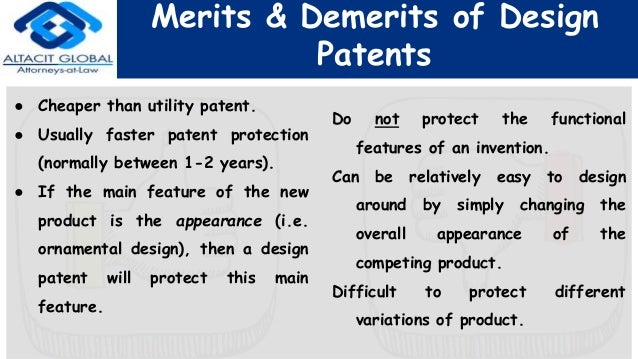
Design patents have a much lower initial rejection rate than utility patents. In fact, many design patent application receive first action allowance. This is so because design patents are much more straightforward and visual, making it easier to examine than utility patents. Design patents often cost a fraction of what utility patent cost because utility patents can easily end up costing $10,000+. This is so because attorneys require a lot of time to prepare and draft utility patent application, and they may also have to deal with any rejections from the patent office. Please note that although utility patent last longer than design patents, inventors will have to pay utility patent maintenance fees at 3.5 years, 7.5 years, and 11.5 years.
In some limited cases, black and white photographs may be used in place of drawings, but only if photographs are the only practicable medium for illustrating the invention. Design patents have a term of 15 years from the date of issuance, and no maintenance fees are necessary. Cross-references to other related patent applications may be made in an initial section of the description when appropriate. Both design patent application and utility patent application should be filed if protection is desired both for the aesthetic appearance of the article as well as its functional aspects.
Many countries, including Australia, Japan, China and most ofEurope, offer a shorter-term alternative to a utility patent calleda utility model. Theeligibility standards are considerably lower than those for astandard patent because there is no substantive examinationrequirement. This is a critical question that you need to resolve early in your patent journey.


No comments:
Post a Comment